 “His mother said, ‘Young man, why have you done this to us? Your father and I have been half out of our minds looking for you.” (Luke 2:48, The Message)
Several years ago I went to a very large mall to buy a wedding shower gift. Like most modern malls, this was a city unto itself. My sons, ages six and five at the time, went with me. Riding escalators and winding through aisles of house wares is always an interesting task with curious little boys. Mothers never cease to be amazed when they successfully achieve their shopping goals under such circumstances. That was true of me that day. The boys and I managed to find our way to the linen department of the store where I intended to search for the desired gift. Thankfully, I found the gift almost immediately. Just as quickly, I lost something else. When I looked up from matching the gift to the registry listing, my five-year-old was right by my side, but his big brother was nowhere in sight. We called his name and searched around the displays of towels and sheets, displays that surely seemed more like towers in the eyes of five and six-year-olds. “He couldn’t have gotten very far in that amount of time,” I reasoned to myself. As panic began to set in, I wondered if he had decided to go for another ride on the nearby escalator. No, he was nowhere near the escalator. People, people, everywhere and no sign of my son! Anger over his straying gave way to fear for his safety, as I headed back to the linen department and told a clerk that I needed to report a missing child. She called security; as I waited for a guard to arrive I paced around the corner into the electronics department. There, staring up at a mesmerizing television screen, stood my son. I’m not sure what I said to him (after I ran to hug him) but I’m sure it was something akin to, “Why did you do that to me? I was going crazy looking for you!”
I remembered this incident when I recently reread the story of the nativity. Though I’ve read the story many times this was the first time I found myself thinking about “Mariology,” the teachings and traditions of the Roman Catholic Church that exalt Mary, the mother of Jesus, in ways not supported by Holy Scripture. If you want an in-depth analysis of Mariology, this is not the place to read. My observations come from simply recognizing the common bond of motherhood with Mary. In reading Luke’s gospel this time, I was struck by the fact that in a mere two chapters, he takes us from a Mary to whom no other woman can relate (by virtue of the immaculate conception) to a woman with whom any mother can closely identify. I think Luke, anticipating potential heresies, intentionally and quickly gives us glimpses of Mary’s motherhood. After telling us of the one, unparalleled miraculous event that happened in Mary’s life in Chapter One, Luke then takes the time to relate two more “Mary” stories in Chapter Two. First, Mary gave birth under less than desirable circumstances. Second, she knew the panic of a missing child. Of both of Mary’s experiences, Luke says that Mary treasured these things in her heart.
How did Luke know that Mary treasured these things? Surely, it was because she marveled over these incidents to those close to her. This is what we women do; we recount our motherhood experiences. I can imagine Mary saying, “I remember the night Jesus was born…” or “I remember the time Joseph and I couldn’t find Jesus…” Of course, there were special, supernatural things at work in Mary’s experiences, too. Shepherds found out about Jesus’ birth via angelic beings and came to worship Him. Then, later, Mary found her Son amazing the temple elders with His understanding and answers. But these supernatural experiences don’t alienate Mary from me. That she marveled at these things assures me that Mary was just as human as I am. I don’t think it’s an accident that Luke goes out of his way to tell us (twice) that Mary was pondering and marveling over these events. Would a woman who herself possessed god-like qualities have been so amazed? I don’t think so. I think Mary, a mother like me, was also a sinner like me. When her Son later proclaimed, “I am the way, and the truth, and the life; no one comes to the Father, but through Me,” He was surely including His mother.
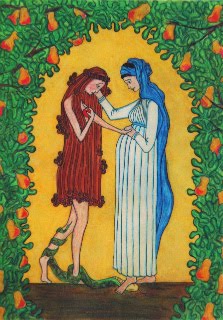
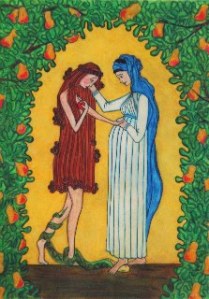
A note on the above work of art, Mary Consoles Eve: Thanks to my friend, Christine, for helping me to discover this beautiful crayon and pencil drawing by Sister Grace Remington of the Sisters of the Mississippi Abbey. Note how Sister Grace stays true to Catholic teachings by showing Mary (rather than Mary’s “seed,” i.e., Christ) bruising the serpent’s head.

 Do you have a Go-To CD? One that you play anytime your soul is thirsting for truth and encouragement? The one you play when the worries of this world are weighing heavily upon your shoulders? Driving to church last Sunday, I realized that I do have such a CD. It’s Overjoyed by 40 Miles North. The title track, which includes the lyric, “And today if it’s sunshine or rain, if it’s pleasure or pain, I will not be afraid – Cause You promised me that You’re gonna be always faithful – Always right beside me,” is just one of the 13 tracks which consistently deliver messages that weary souls long to hear. Actually, I often don’t even realize that my soul needs these reminders until I play the CD. Then, as the music seeps into my dulled brain and floods my crackly heart, I know I’m being transformed from a dried up sponge to a pliable, renewed being. And it’s not a sappy, syrupy renewal. This music softens, but that is because it is so firmly rooted in a solid foundation of truth.